.png)


Achieve Your Dreams: Using Hypnosis and Neuroscience to Rewire Habits
- Jason Medlock
- Dec 13, 2025
- 11 min read

If you feel stuck in a cycle of habits that hold you back from your goals, you are not alone. The desire to achieve your dreams is a powerful motivator, but motivation alone often isn't enough to create lasting change. The key lies not in willpower, but in understanding and rewiring the automatic patterns that run your life on autopilot. This guide provides a practical, science-based framework, combining modern neuroscience with the focused power of hypnosis, to help you take control of your subconscious programming and build the life you envision.
This is not about mystical claims or quick fixes; it's about giving you actionable tools to systematically update limiting beliefs and forge new neural pathways that support your ambitions.

Why Motivation Isn’t Enough (Your Brain Runs on Patterns)
We’ve all experienced the surge of inspiration that makes us feel certain this time will be different. You commit to a new goal—starting a business, learning a skill, adopting a healthier lifestyle—only to find yourself back in old routines weeks later. This isn't a failure of character or a lack of desire; it's a testament to the efficiency of your brain.
Your brain is designed to conserve energy by automating as much as possible. It accomplishes this through habit loops: a three-step neurological pattern that drives a significant portion of your daily behavior without conscious thought. Understanding this loop is the first step toward breaking free from it.
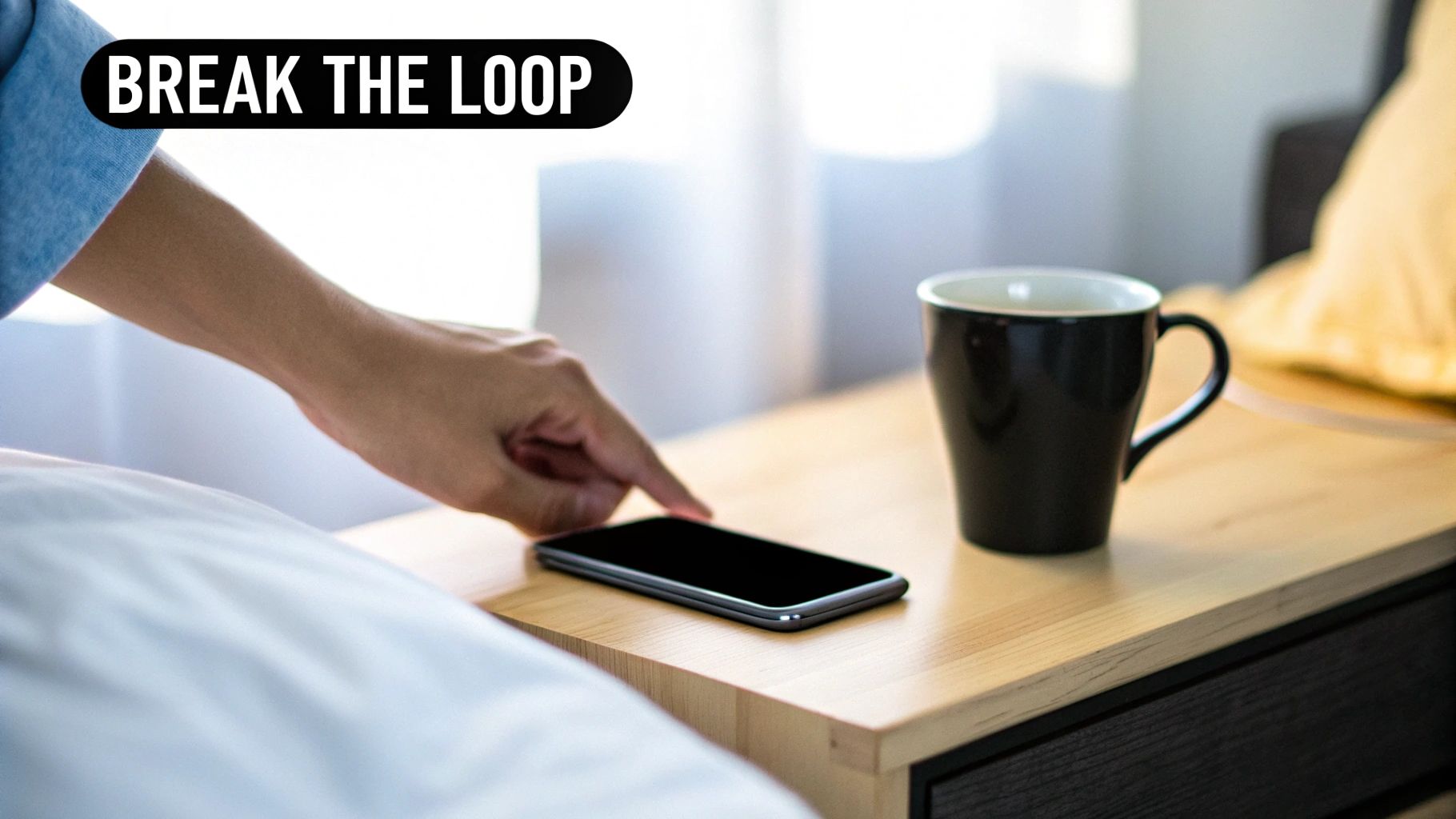
Let's break down a common habit loop: mindless social media scrolling.
Cue: You feel a moment of boredom or a spike of stress. This feeling is the trigger.
Routine: Without thinking, you pull out your phone and begin scrolling. This is the automatic, ingrained behavior.
Reward: Your brain receives a small hit of dopamine from the novelty on the screen, which reinforces the connection between the cue and the routine.
This process is why fighting a bad habit with willpower feels like an uphill battle. Your conscious mind wants change, but your subconscious, running on these efficient loops, defaults to what is familiar. To achieve your dreams, you must align your subconscious programming with your conscious goals.
Neuroscience Insight
Your brain possesses an incredible capability called neuroplasticity. This means it can physically reorganize its own structure and function by forming new neural connections throughout your life. Every time you consciously choose a new action over an old habit, you are actively weakening the old neural pathway and strengthening a new one. This isn't just a psychological concept; it is the biological process of rewiring your brain's hardware to support the person you want to become.
What Hypnosis Really Is (And What It Is Not)
To effectively use hypnosis to achieve your dreams, it is essential to first dispel common misconceptions. Forget the sensationalized portrayals in movies and stage shows. Therapeutic hypnosis is not mind control, magic, or a state of unconsciousness.
Hypnosis is a completely natural state of focused attention combined with a heightened receptivity to suggestion. You experience hypnotic-like states every day. Have you ever been so absorbed in a book that you lost track of time? Or driven a familiar route and arrived at your destination without remembering the specific turns? That is a state of deep, focused concentration. During hypnosis, you are not asleep; you are simply dialed in, aware, and always in control.
The therapeutic power of hypnosis lies in its ability to temporarily quiet the conscious, analytical part of your brain—the "inner critic" that judges, doubts, and resists change. By relaxing this critical filter, we can communicate directly with the subconscious mind, where your core beliefs, emotions, and automatic habits are stored. This allows for the introduction of new, empowering suggestions that align with your conscious goals, helping to rewrite the unhelpful programming that has been holding you back.
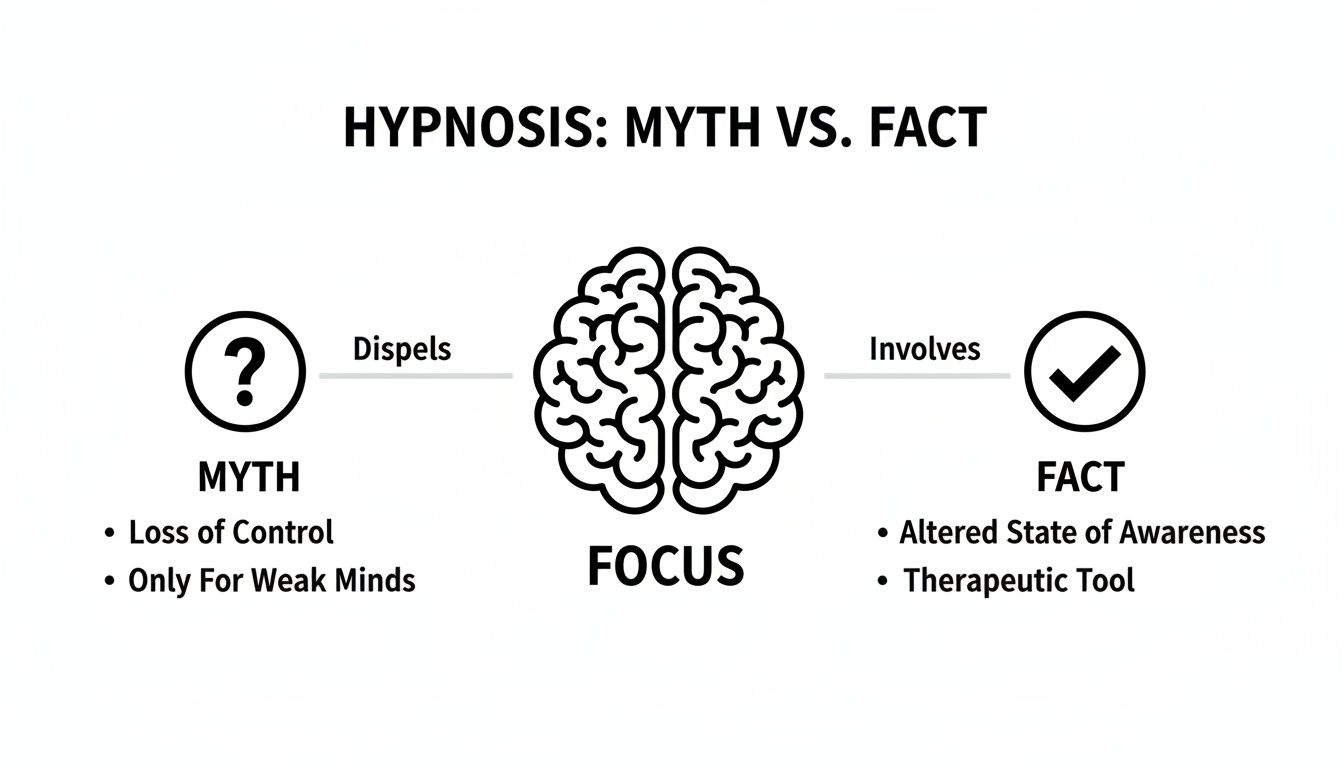
Myth vs Fact
Myth: You lose control and can be made to do things against your will.Fact: You are always in control during hypnosis and cannot be forced to violate your personal values. It is a state of heightened awareness, not unconsciousness.
Myth: Hypnosis is a form of sleep.Fact: Brainwave patterns during hypnosis show a highly active, focused state of mind, completely different from sleep.
Myth: Only "weak-minded" people can be hypnotized.Fact: The ability to be hypnotized is linked to intelligence, creativity, and the ability to focus—it is a skill that can be improved with practice.
Myth: You might get "stuck" in a hypnotic state.Fact: It is impossible to get stuck in hypnosis. The state ends naturally, much like a daydream. At worst, you might drift into a light sleep and wake up refreshed.
The Neuroscience Behind Hypnosis and Behavior Change
The effectiveness of hypnosis in changing behavior is grounded in modern neuroscience. The process directly influences your brain's structure and function, creating the ideal conditions for personal transformation.
Your prefrontal cortex (PFC) acts as the brain's CEO—responsible for analytical thought, planning, and willpower. It is also the source of the inner critic that often resists new ideas. During the focused state of hypnosis, activity in the PFC temporarily decreases. This quieting of the analytical mind creates a window of opportunity where the subconscious becomes more receptive to new suggestions without the usual skepticism.
This state allows us to directly address the habit loop (cue → routine → reward). For example, if stress (the cue) automatically triggers a desire for junk food (the routine), hypnosis can help install a new, healthier response, such as taking a few deep, calming breaths. By rehearsing this new response in a receptive state, you begin to build and strengthen a new neural pathway. This is neuroplasticity in action. You are not just fighting an old habit; you are giving your brain a new, more effective blueprint to follow. Over time, the new, empowering behavior becomes just as automatic as the old one was.
Hypnosis Tip
Always frame hypnotic suggestions in positive, present-tense language. Instead of saying, "I will not procrastinate," try, "I am focused and take action easily." Your subconscious mind responds much more effectively to what you want to create, not what you want to avoid. This small shift in wording makes a huge difference in how your brain receives and acts on the new instruction.
A Simple 10-Minute Hypnosis Practice to Move Toward Your Dream
Understanding the science is the first step; experiencing it is where true change begins. This guided self-hypnosis exercise is designed to give you a tangible sense of the focused state and demonstrate how you can use it to begin rewiring an automatic habit like procrastination. Find a quiet place where you will not be disturbed for 10 minutes. You may wish to record yourself reading the script slowly and play it back with your eyes closed.
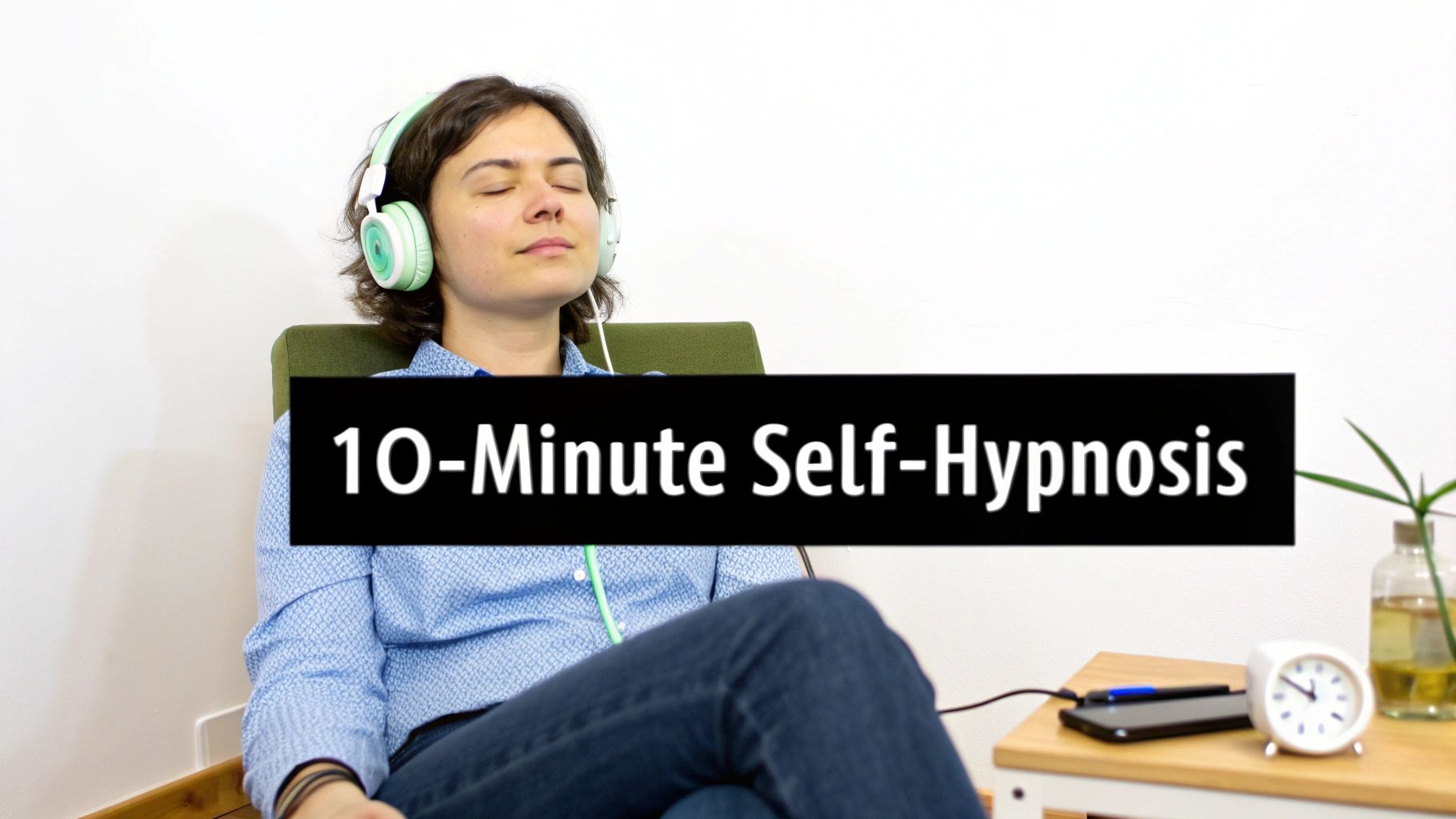
Self-Hypnosis Script for Confident Action
Find a comfortable position, either sitting or lying down, and gently close your eyes.
Begin by taking a long, slow breath in... and as you breathe out, allow your body to soften. Take another deep breath, filling your lungs... and as you release it, feel the tension leaving your shoulders and your jaw. One more deep breath... and on the exhale, allow your body to feel heavy, supported, and secure.
Now, bring your attention to the top of your head. Imagine a warm, gentle wave of relaxation slowly washing down over your entire body. It moves across your scalp and forehead, smoothing the muscles around your eyes... it flows down over your cheeks and jaw, releasing any tightness... it continues down your neck and into your shoulders, melting away any accumulated stress.
This peaceful feeling flows down your arms to the tips of your fingers... down through your chest and your back... all the way down through your legs to the very tips of your toes. With each breath, you allow yourself to drift even deeper into this wonderfully calm and focused state.
As you rest here, I want you to picture a version of yourself who takes action with complete ease and confidence. See this person clearly in your mind's eye. Notice their posture, their focused expression, the purposeful way they move. They are not struggling; they are energized, engaged, and aligned with their goals. This is the you who is ready to achieve your dreams.
Now, in your mind, step fully into that image. Feel what it feels like to be this person. Experience the sense of accomplishment, the quiet pride, and the calm focus that come from doing what needs to be done. Let this feeling of empowerment fill every cell of your being.
From this moment forward, whenever you notice the old impulse to procrastinate, that will be your new signal. It will be your cue to take one deep, calming breath and instantly reconnect with this powerful feeling of focused action. Action feels good. Progress is energizing. You are focused, capable, and in control.
When you are ready, you can slowly begin to bring your awareness back to the room around you, feeling refreshed, focused, and ready for what is next. Take all the time you need. Open your eyes when you feel ready, carrying this wonderful feeling with you into your day.
Why People Slip Back (And How to Prevent It)
Creating lasting change is rarely a linear process. Moments of reverting to old habits are a natural part of the journey, not a sign of failure. When you are tired, stressed, or distracted, your brain defaults to the most energy-efficient neural pathway—the old, familiar habit. Understanding this allows you to approach setbacks with curiosity instead of criticism.
Instead of viewing a slip as a failure, see it as valuable data. What was the trigger? What was the context? Stress, exhaustion, and boredom are common culprits that weaken conscious resolve and allow subconscious programming to take over. The most effective strategy is to anticipate these high-risk moments and have a plan in place before they occur. This proactive approach turns potential setbacks into opportunities for reinforcement.
Relapse Prevention Checklist
Use this checklist to create a proactive strategy for maintaining your progress, especially during moments when your willpower is low.
Strategy | Action Step |
|---|---|
Identify High-Risk Situations | Write down 3-5 specific scenarios where you are most likely to revert to old habits (e.g., late-night work, social pressure, feeling overwhelmed). |
Pre-Plan an Alternative Response | For each high-risk situation, define a new, positive action. Example: "If I feel an afternoon energy slump, I will take a five-minute walk outside instead of reaching for sugar." |
Practice Self-Compassion | If you slip, acknowledge it without judgment. Say to yourself, "That happened. It's part of the process. What can I learn from this for next time?" |
Reconnect With Your "Why" | Keep a visual reminder of your ultimate goal somewhere you will see it daily. When tempted, look at the reminder to tap back into the powerful emotion behind your desire to change. |
By treating relapse prevention as a skill to be developed, you cultivate resilience and ensure that you remain the architect of your transformation. You are not just breaking old habits; you are consciously building a new way of being.
How Quit for Life™ Fits Into Achieving Your Dreams
While self-hypnosis is a powerful tool for general improvement, certain deep-rooted habits, like smoking, often require a more structured and specialized approach. Quitting smoking is a profound step toward achieving your dreams of better health, freedom, and self-mastery. The Quit for Life™ program is specifically designed to address the complex layers of this habit.
This is not a generic, one-size-fits-all solution. It is a targeted, three-session program that combines advanced hypnosis techniques with a deep understanding of the neuroscience of addiction. Each session builds upon the last, creating a comprehensive framework for lasting change.
Session One: Identity and Trigger Mapping. We go beyond the surface-level habit to dismantle the "smoker" identity. We identify and map your unique triggers—the specific cues that drive the urge to smoke—to understand the habit's underlying structure.
Session Two: Hypnosis and Trigger Neutralization. In a deep hypnotic state, we work to neutralize the emotional charge of your triggers. We install new, healthier responses, effectively rewriting the old cue-routine-reward loop at the subconscious level.
Session Three: Future Self Installation and Relapse Prevention. We powerfully install the identity of a healthy, vibrant non-smoker. You will experience what it feels like to be free, confident, and in control. We also equip you with practical relapse prevention strategies to ensure your success is permanent.
By addressing the identity, triggers, and future self, Quit for Life™ provides the support and structure needed to make one of the most significant changes of your life, freeing up your energy and resources to achieve your biggest dreams.
The “Achieve Your Dreams” Framework (Steal This)
Turning a dream into reality requires a repeatable process. This framework combines neuroscience and hypnosis into a practical, three-pillar system for creating meaningful change. It is a cycle of Clarity, Reprogramming, and Reinforcement.
Pillar 1: Clarity and Intention
You cannot achieve a goal you have not clearly defined. The first step is to get specific about what you truly want and, more importantly, why you want it.
Define Your Vision: Describe your ideal future in vivid detail. What does a typical day look like? How do you feel? What impact are you making?
Identify the Limiting Belief: What is the single core belief that holds you back? Common examples include "I'm not good enough," "I don't deserve it," or "It's too late." This is the belief we will target for reprogramming.
Pillar 2: Subconscious Reprogramming
This is where you update your internal operating system. Using focused techniques like self-hypnosis, you can bypass the critical conscious mind and install a new, empowering belief directly into your subconscious. This is the most efficient way to give your brain a new set of instructions that align with your vision.
Pillar 3: Consistent Reinforcement
A single breakthrough is powerful, but consistency makes it permanent. The goal is to integrate your new belief into your daily life until it becomes your automatic reality.
Daily Practice: Dedicate 5-10 minutes each day to self-hypnosis or vividly imagining yourself having already achieved your goal. Feel the emotions of success.
Action Aligned with Identity: Throughout your day, ask, "What would the version of me who has already achieved this do right now?" Then, take that small action.
This framework is a continuous cycle. By committing to this process, you build unstoppable momentum, making the journey to achieve your dreams feel less like a struggle and more like an inevitability.
Next Step
Understanding the science behind your habits is the first step. Taking decisive action is the next step. If you are ready to break free from limiting patterns and build a structured path toward your goals, professional guidance can make all the difference.
For deep-rooted habits like smoking, the Quit for Life™ program offers a proven, three-session framework to help you reclaim your health and freedom for good. The principles we use—dismantling old identities, neutralizing triggers, and installing a powerful future self—can be applied to help you achieve any dream.
Take the next step in your transformation. Contact me to learn how a structured hypnosis program can provide the blueprint you need to rewire your habits and build the life you truly desire.
Jason MedlockLevel 2 QHHT PractitionerCall: 281.309.7106Visit: www.hypnosawakening.com
FAQs
1. How will I know if hypnosis is working?Most people do not feel "hypnotized" in a dramatic way. Instead, you will likely experience deep physical relaxation while your mind remains clear and highly focused. The true evidence that it is working will be the positive changes you begin to notice in your thoughts, feelings, and behaviors in your daily life.
2. Is hypnosis safe?Yes. Hypnosis is a natural state of mind, and when guided by a trained practitioner, it is a completely safe, non-invasive therapeutic tool. You are always in control and cannot be made to do anything that violates your personal values.
3. Can anyone be hypnotized?Nearly everyone with an average intelligence and the ability to focus can be hypnotized. The only requirements are a willingness to participate and a genuine desire for change. It is a skill, not a trait.
4. What if I can't visualize well?That is perfectly fine. Visualization is only one of many tools used in hypnosis. We can work just as effectively with feelings, internal dialogues, sounds, and direct suggestions. The process is always tailored to how your individual mind works best.
5. How many sessions are needed to see results?While a single session can produce significant insights, lasting change for deep-rooted habits is a process. For a goal like quitting smoking, a structured multi-session approach like the three-part Quit for Life™ program is most effective, as it builds a comprehensive foundation for permanent success.

Comments